Web, Mobile & Software Engineering
Headless Drupal + Next.js Development
Headless Drupal development with fast Next.js front ends. Decoupled CMS builds and migrations for businesses that need speed, security and flexible content.
Quick answer
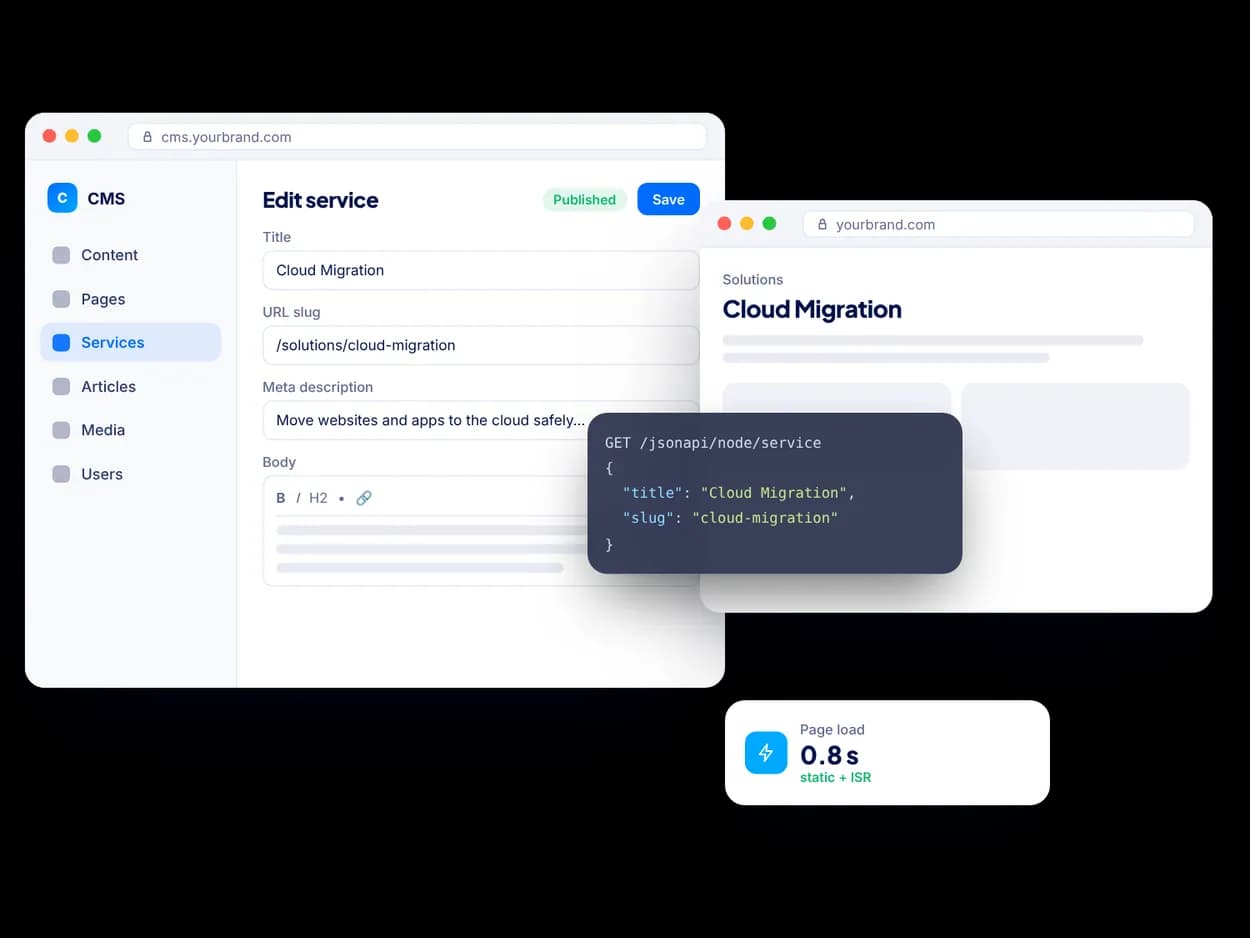
Our headless Drupal development pairs Drupal back ends that editors love with Next.js front ends that load instantly, connected through JSON:API. A headless CMS separates content management from the website front end.
Available to small and mid-sized businesses in United States, United Kingdom, United Arab Emirates, Saudi Arabia, India and worldwide, delivered remotely from India.
What is a headless CMS?
In a traditional CMS, the same system stores content and renders web pages. In a headless (or decoupled) CMS, the CMS only manages content and delivers it through an API. A separate front end, such as a Next.js website or a mobile app, displays that content. This makes the site faster, more secure and easier to redesign without migrating content.
Why use Drupal and Next.js together?
- Drupal provides structured content types, roles and permissions, revisions, multilingual support and a mature, open-source ecosystem.
- Next.js delivers pages as pre-rendered static or server-rendered HTML for excellent Core Web Vitals and SEO.
- JSON:API is built into Drupal core, so there is no custom API layer to maintain.
- Security improves because the public website and the admin system live on separate servers and domains.
What does a headless Drupal development project include?
- Content modelling: designing content types and fields around how your team actually publishes.
- Drupal setup, editor experience, roles and workflows.
- Next.js front end with static generation and on-demand revalidation, so edits appear in seconds.
- SEO and AEO foundations: metadata, structured data, sitemaps and AI-crawler access.
- Migration from WordPress, older Drupal versions or other CMSs, with redirects to protect rankings.
- Hosting on Vercel, AWS or your preferred cloud, plus monitoring and backups.
When is headless the right choice?
Headless Drupal development is a strong fit when site speed matters for revenue, when the same content feeds a website and an app, when you need multiple languages or brands, or when security requirements are high. For a simple brochure site, a well-built WordPress or traditional Drupal site may be more cost-effective, and we will tell you so.
Read more: Why headless Drupal + Next.js is a smart stack for growing businesses.
Ready to talk? Tell us about your project and a senior engineer will reply with next steps, questions and a suggested approach.
Headless Drupal + Next.js Development: FAQs
What is the difference between headless and traditional Drupal?
Traditional Drupal stores content and renders the web pages. Headless Drupal only stores and manages content, and a separate front end such as Next.js renders the pages by reading content through Drupal's JSON:API.
Is a headless website good for SEO?
Yes, when built correctly. Next.js outputs fully rendered HTML, fast load times and clean metadata, and we add structured data, sitemaps and canonical URLs so search engines and AI assistants can read every page.
Can editors still preview and publish content easily?
Yes. Editors work in the familiar Drupal admin, and changes are pushed to the live Next.js site automatically within seconds through on-demand revalidation.
Can you migrate our WordPress site to headless Drupal?
Yes. As part of headless Drupal development, we map your existing content to new content types, migrate posts, pages and media, and set up redirects so you keep your search rankings.