
Dedicated Developers vs Fixed-Price Projects vs Freelancers: How to Choose
By Digitexa AI ·
- Type
- Blog Post
- Topic
- Dedicated developers vs fixed price
- Reading time
- 5 min read
- Published
- 2 November 2026
Key takeaway
Short answer: Choose a fixed-price project when the scope is small, clear and unlikely to change. Choose dedicated developers when the work is ongoing or the requirements will evolve, and you can give the team direction. Choose a freelancer for short, well-defined tasks where one skill set is enough and you can manage the risk of a single person.
What is the difference between the three models?
All three models get software built. The difference is who carries the risk, who directs the work and how you pay.
- Fixed-price project: a supplier agrees to deliver a defined scope for an agreed price and timeline. The supplier carries the estimation risk. You carry the risk that the scope was wrong.
- Dedicated developers: you get one or more developers who work only on your product, usually for a monthly fee per person. You direct the priorities. You carry the risk of how the time is used.
- Freelancers: independent individuals you hire per task or per hour. You manage them directly. You carry most of the delivery and continuity risk.
How do the models compare side by side?
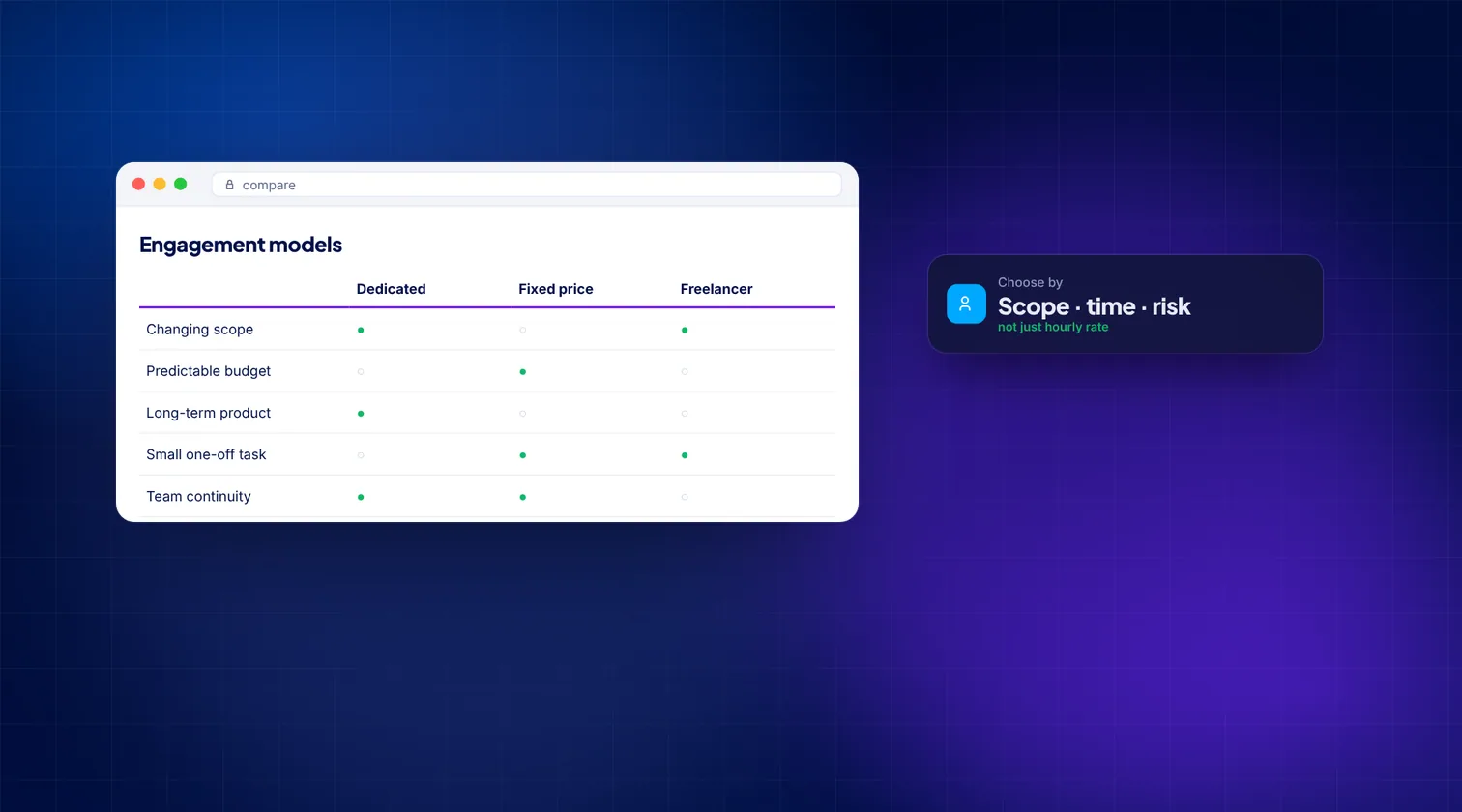
| Factor | Fixed-price project | Dedicated developers | Freelancers |
|---|---|---|---|
| Best for | Clear, stable scope | Ongoing or evolving products | Small, isolated tasks |
| Flexibility to change scope | Low (change requests) | High | Medium |
| Budget predictability | High for the agreed scope | Predictable monthly spend | Varies with hours |
| Your management effort | Low to medium | Medium | High |
| Team depth (QA, design, DevOps) | Usually included | Add roles as needed | Usually one skill set |
| Continuity and knowledge retention | Ends with the project | Strong over time | Depends on one person |
When does a fixed-price project make sense?
Fixed price works well when you can describe what "done" looks like before work starts. A brochure website, a defined integration between two systems or a first version of an app with a tight feature list are good examples.
Strengths
- You know the cost and timeline up front, which helps with approvals.
- The supplier manages the team, testing and delivery.
- Milestone payments tie money to visible progress.
Watch-outs
- Suppliers add a buffer to cover uncertainty, so vague scopes cost more.
- Every change becomes a change request, with its own quote and delay.
- There can be pressure to meet the letter of the specification rather than the intent.
The quality of your brief decides how well this model works. A clear brief gives tighter quotes and fewer disputes. If you are preparing one, see our guide on writing a software project brief.
When are dedicated developers the better choice?
Dedicated developers suit businesses that are building a product over months, not weeks. A SaaS platform, an internal system that keeps growing or a long-running backlog of improvements all fit this model.
Strengths
- You can reprioritise every sprint without renegotiating a contract.
- The team learns your business, code and customers, so they get faster over time.
- You can scale up or down by adding or removing people.
- You keep close control over quality, tools and process.
Watch-outs
- You need someone to own the backlog and make product decisions, either in-house or through the supplier.
- Spend is tied to time, not outcomes, so you must track progress against goals.
- A single developer cannot cover every skill. You may need design, testing or DevOps support as well.
Our dedicated developers service is built around this model, with the option to add a project manager if you do not have one.
When should you hire a freelancer?
Freelancers are a good fit for contained tasks: fixing a plugin, building a landing page, writing a script or adding a small feature to an existing site. They are often quick to start and flexible on hours.
Strengths
- Fast to hire for a single skill.
- Pay only for the hours or task you need.
- Useful for specialist one-off work.
Watch-outs
- If the freelancer becomes unavailable, the work stops and knowledge leaves with them.
- Code review, testing and documentation are often lighter unless you ask for them.
- You handle access, security and quality checks yourself.
- Combining several freelancers means you become the project manager.
What drives the cost of each model?
Each model prices risk and effort differently. Rather than comparing headline rates, look at the total cost of getting a working result.
- Fixed price: scope size, clarity of requirements, number of integrations, design complexity and the supplier's buffer for unknowns.
- Dedicated developers: seniority, number of people, length of commitment and extra roles such as QA or project management.
- Freelancers: hourly rate, hours actually billed, and your own time spent managing, reviewing and fixing.
A cheaper hourly rate can end up costing more if work is redone or your own time is consumed managing it. Count your internal effort as a real cost.
Location also plays a part. Remote teams in India, for example, often offer good value for dedicated work, provided time-zone overlap and communication are planned. Ask any supplier how many working hours overlap with yours, who your day-to-day contact will be and how quickly urgent issues are picked up. These practical details matter as much as the rate itself, and they are easy to agree before you start.
How do you choose the right model for your project?
Answer these questions honestly. The pattern of answers usually points to one model.
- Can you write down the full scope today? If yes, fixed price is viable. If not, lean towards dedicated developers.
- Will the work continue after launch? Ongoing work favours dedicated developers.
- Do you have someone to manage priorities? If not, choose fixed price or a dedicated team that includes a project manager.
- How many skills are needed? One skill and a short task suits a freelancer. Several skills suit a team.
- How costly is a delay or failure? For business-critical systems, avoid depending on a single person.
- How important is budget certainty? Approval processes that need a fixed figure favour fixed price for phase one.
Can you combine the models?
Yes, and many businesses do. A common pattern is a fixed-price discovery and first release, followed by a dedicated team for ongoing development. This gives budget certainty for the riskiest phase and flexibility afterwards.
Another pattern is a small dedicated core team supported by specialists for short bursts, such as a security review or a performance audit. The key is that one party owns the overall architecture and quality, so the pieces fit together.
What should be in the contract whichever model you choose?
- Clear ownership of the code and intellectual property once paid for.
- Access to the code repository from day one, under your own account where possible.
- Confidentiality and data protection terms that suit your region, such as UK GDPR or India's DPDP Act.
- A definition of "done", including testing and documentation.
- Notice periods and a handover process if the arrangement ends.
- Communication rhythm: stand-ups, demos and reporting.
How Digitexa AI can help
We offer fixed-price projects and dedicated developers, and we will tell you which one suits your situation. If you are building a product that will keep growing, our SaaS development and dedicated developer teams are a good place to start. Get in touch to talk through your project.
Frequently asked questions
Is a fixed-price project cheaper than dedicated developers?
Not necessarily. Fixed price includes a buffer for uncertainty, and changes cost extra. For long or evolving work, a dedicated team often gives better value because effort goes straight into the product.
How many dedicated developers does a small business need?
Many small businesses start with one or two developers plus part-time support for design, testing or project management. You can add people as the backlog grows.
Are freelancers suitable for building a full product?
It is possible, but risky. A full product needs several skills and continuity, so relying on one or a few freelancers puts delivery and knowledge at risk.
Can I switch from fixed price to a dedicated team later?
Yes. Many businesses run a fixed-price first release and then move to a dedicated team for ongoing improvements, often with the same supplier for continuity.
More insights
How to Estimate Timeline and Cost of Custom AI Chatbots
Discover how to calculate the timeline and custom AI chatbots cost for customer support, including key scope drivers and integration factors.
Read moreDedicated Developers vs Fixed-Price Agencies
Compare hiring dedicated developers with fixed-price project agencies to find the right resourcing model for your business software development.
Read moreHow to Choose a Web and Mobile App Development Agency
Discover the essential questions to ask a web and mobile app development agency before signing any contracts to protect your investment.
Read more